

The FLINTAverse
Sally Olds investigates the rapid rise of a new queer acronym.
NB: The following piece required such intensive investigation that our usual Thursday publication schedule had to be pushed back. Instead, please settle in for a leisurely weekend long-read.
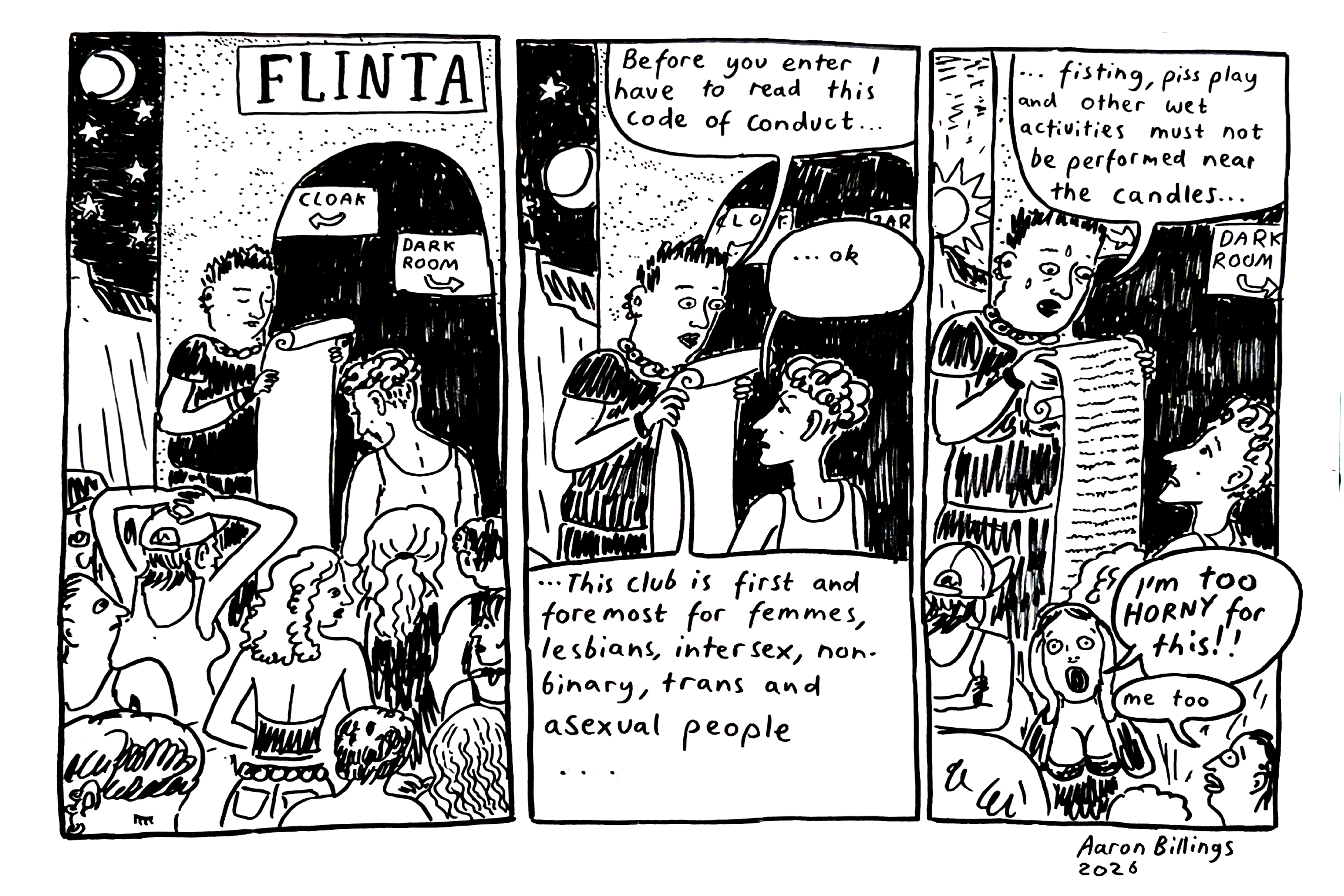
On a recent sunny Friday afternoon, I pushed open a glass door off Scotchmer Street and entered Bernie’s, Naarm’s first self-proclaimed FLINTA bar. FLINTA is a German acronym that stands for “frauen, lesben, intergeschlechtliche, nichtbinäre, agender/transgender.” In English, this is usually translated as femme/female, lesbian, intersex, nonbinary, agender/transgender. It’s the new queer shorthand that, unlike the more-familiar LGBTQIA+, excludes all cis men. In the last decade or so, it has taken root in Berlin’s nightlife, especially in venues with sex-on-premises darkrooms, where it is the subject of bitter debate among the queer community. This mostly takes the form of turf wars between cis gay men, who have dance floor hegemony, and militant dykes, who want (dark)rooms of their own, or at least a share in what’s already going. And because there is a robust Berlin-to-Naarm pipeline—Melburnians read Vincenzo Latronico’s novel Perfection and experienced it as an excruciating satire of inner-north millennial lifestyles, despite it being set in Berlin—FLINTA has recently arrived in our city, borne across the oceans by cheap Scoot flights and wordy infographics.
Inside the bar, I greeted Cam, my co-editor, and ordered a non-alcoholic beer. The room was accented by dark timber and lit by lace-swaddled pendant lights. I was wearing a grey singlet. So was Cam (though hers was ribbed). So was everyone else, although most people’s singlets were white or black rather than grey. In the courtyard, the only people who weren’t dressed in pristine monochrome singlets, baggy jeans (on the mascs), baggy jeans with peeping fishtail (on the femmes), and bedazzled, bleach-stained caps (on everyone), were two curly-haired French lesbians who were either identical twins or a couple in the final stages of merging. There were also two friends, in their late thirties or early forties, one in a crocheted dress over galaxy tights, the other with a shaved head and large hoop earrings, who had furtive, speedy mannerisms, and the slightly unnerving physicality of somatics practitioners. That, or they were holdover circus queers from the 2010s. Other than these anomalies, it was South Yarra in the north. There were no sensory headphones or keffiyehs or filthy tote bags, as there would have been at Beans (RIP) or Flippy’s. The people here were clean, toned, young. Even some of the mascs had lip filler.
Over the summer just passed, I’d begun to see the new acronym used more and more. Like Kath Day-Knight on her quest to discover Kim’s lesbianism, I roamed the streets (and my Explore page) and saw signs of it everywhere. A FLINTA bikepacking group. A FLINTA bookclub. A FLINTA life-drawing class. Mostly, though, I saw it on event posters for DIY or small-scale raves and club nights, which is what interested me most. For years now, millennials in Naarm had partied under the sign of “queer” and worked under the sign of “LGBTQIA+.” I wondered if FLINTA was the Alpha-Zoomer reboot, cleaving not just the queer community but the generations within it. I hadn’t exactly chosen these earlier identity markers—more inherited them—and if there was to be a changing of the guard, and with it, the jargon, I wanted to at least understand what we were getting into. Trends that seem confined to the darkest of darkrooms can spread rapidly to the mainstream. And when these trends are absorbed by corporate culture and government policy, they can terrorise you for years to come. If you don’t want to get $50 cash out from a FLINTATM (like the infamous rainbow diamante-encrusted “GayTMs” in Sydney) at the 2036 Mardi Gras, it would be prudent to take stock now.
The courtyard at Bernie’s filled up around us. People had brought their dogs, who cruised each other at knee height, bringing their owners into conversation. A trio of gay men arrived, all wearing long socks and short shorts. “Gays!” I hissed to Cam. Normally a placid fag hag, my first real contact with a FLINTA space had me acting like the gender police. One of the men nursed a chihuahua, which he passed over to a cooing dyke to mind while he ordered a drink. FLINTA was new here, and the rules of engagement were not yet set. Perhaps it wasn’t so serious; perhaps it was just a fun Berlin party export, like Club-Mate. Still, I fretted. By adopting FLINTA locally, were we importing a bad solution to a problem we don’t have—but that we might unwittingly create?
*
r/Berghain_Community
Whole Festival Reviews
2y ago
Fighterfire1986
2y ago
Two years ago flintas had a lot of complaints and I was so happy that the organisation took action on many of their points last year...They introduced flinta-only toilets, flinta-only cruising area with literally a guard standing at the door 24/7. I thought these were fantastic improvements and flintas would have a wonderful time last year and really appreciate the developments. But what did they do? They said they are being pushed away by cis men on the dance floor so they asked the very front of the dance floor to be fenced and only flintas should be allowed in this fenced area. Not even trolling…
Mountain_Arrival1065
7mo ago
Hm…as in general society this privileged, demanding flinta diva victimhood mentality has gone way too far.
Phexi111
2y ago
… the ghb circuit gays kinda kill[ed] the mood. pushing so aggressively in the crowd, not understanding peoples boundaries, getting physically violent while “flirting”, tweaking & the constant passing out … one fell down from a little podium, face first and was lucky that somehow he hit his shoulder on some stairs first. don’t need to see that again tbh.
Whole Festival is a queer, hedonistic, three-day party held about two hours’ drive from Berlin in Ferropolis, an ex-industrial area littered with gigantic decommissioned machines. If Berlin is the daily battleground of FLINTAs and cis gays, then Whole functions as a kind of annual Waterloo.
Anya, like many Berliners, has been drawn into the skirmishes. We met in person at a cafe, as she happened to be visiting Naarm on her way to Sydney’s Mardi Gras. She had long, silky dark hair, impeccable make-up, and wore a Berliner-in-summer look: a black cotton halter top, black tuxedo mini-shorts, and black platform flip-flops. She was neither pro-FLINTA nor anti-FLINTA; she was over it, and had interesting critiques of both sides.
“I went to Whole in 2024,” she told me. She was working there—otherwise she wouldn’t have gone. “I fucking hate festivals. And I fucking hated Whole. First of all, it was so gay-male centric. The way people partied and used drugs there was really dark. At one point on Sunday morning there was a gay orgy on the beach. There were about thirteen guys, and one by one they collapsed. The ambulance would come and take one person away, and then a new person would join in. Then the ambulance would come again, and on it went. The entire morning it was just ‘woo-ooo-woo-ooo’ [imitates siren].”
The young waiter who had been hovering at our table looked ashen. She asked if we’d like to order.
“Two white wines, please,” Anya said.
“Oh, sorry! We don’t serve alcohol here.”
Sparkling water, then. Anya continued. “And then there was this rumour that the FLINTA militia made a bomb threat, and—”
Wait, what? I’d read of one episode in which a FLINTA group, wielding flashlights, stormed a gay darkroom in Berlin, lighting up the sexual inequality of the city’s sex spaces. But a bomb threat?
Keep reading with a 7-day free trial
Subscribe to The Paris End to keep reading this post and get 7 days of free access to the full post archives.