

Shadow Work
Sally Olds gets her fortune told at the MindBodySpirit Festival.
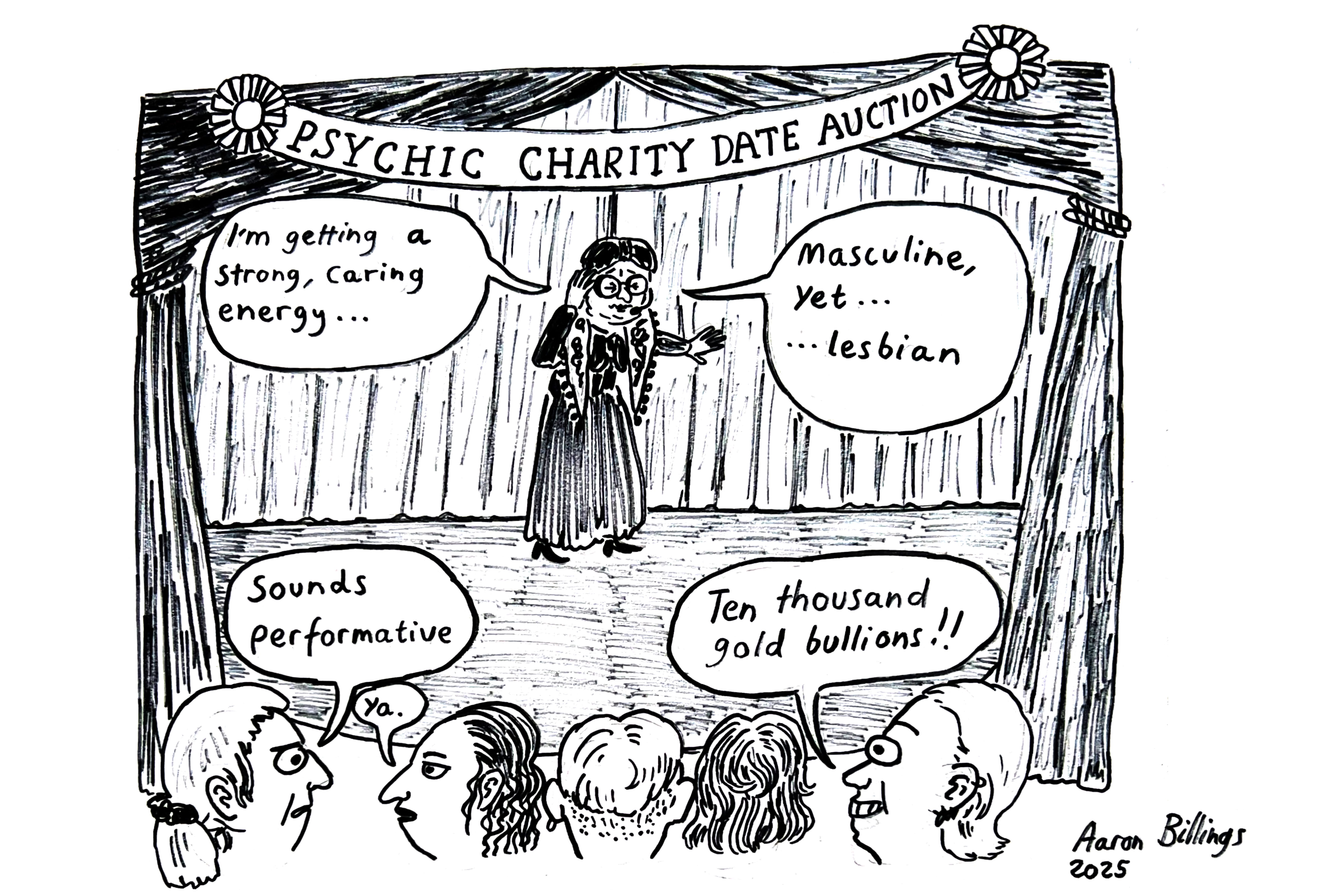
The women at the 2025 MindBodySpirit Festival are nothing like the great-granddaughters of the witches they couldn’t burn. They are not witchy hot girls with uni degrees and co-owned apartments. They are not hexing Donald Trump. They are mostly suburban-dwelling, working-class women, Gen X and older, with a smattering of teens in their best Dangerfield corsets. About half are white women and half Vietnamese and Chinese women; all are, if not literally, then spiritually, aunties. A surprising number of them sport rock-hard crew cuts and low-slung cargo pants and appear to be lesbians, although, as a friend reminds me later, such women often turn out to have thirty-year-long marriages to men. And there are some men here, mostly in the form of supportive husbands, chiropractor stallholders, and (roughly) four or five of the hundred or so psychics. Obviously, I do not consult a male psychic. To consult a male psychic would feel profoundly wrong.
The MindBodySpirit Festival is an annual event held over “three uplifting days dedicated to health, wellness and spirituality.” It’s at the Convention Centre in Southbank, in a grey-and-white hall that fails to be brightened by either the 3x3 metre colour poster of a man with flowers in his beard or the square of astroturf beneath a neon-light-and-streamer wall. Most of the space is taken up by white-capped pavilions offering various wares. There is a stall for free sanitary products, a stall for cherry juice, a stall for live spirit drawing, a stall for aura photography, a stall for iridology, a stall adorned by a poster asking “Team Angel or Team Agent?”, a stall for magnesium sprays and supplements, a stall for reiki, a stall for Ayurvedic medicine, and a stall for Dopamine Lab Nasal Strips, which are small, plastic, adhesive strips that one sticks to one’s nose to, apparently, increase oxygen flow by subtly lifting the nostrils. As the day goes on, more and more people don the fluoro strips, like kawaii nose bandaid girls.
The main attraction, though, and the reason I’m here, is the psychic reading room. This is a large area separated from the rest of the festival by trestle tables and temporary partitions. On the trestles, there are three A3 posters laid out, with times marked on one axis and the names, photographs, and psychic offerings of the practitioners on the other. Inside the grid are small laminated squares printed with the psychics’ names and time slots. You scan the faces, seeking signs of wisdom and kindness, take a square, and pay cash to a man with a pointed goatee and a thin, form-hugging hoodie of emerald green. A half-hour session costs $60, regardless of who you see: a planned economy. (Outside the reading room, among the stalls, there are more psychics, but it’s free-market capitalism out here—a man with a septum piercing is trying to get $65 for 15 minutes, while another charges $30 for 20.) You take your square and come back five minutes before your designated time. Behind the partitions, there is a makeshift waiting room and four rows of small tables. On one side sit the psychics. You perch in your section of the waiting room (it’s divided up in A, B, C, and D) until a woman in tights and a thick leather belt takes you to meet your fate.
For my first session at 10:30am, I’m seeing Helen. Helen has straight, grey, chin-length hair, and looks to be in her sixties. With one hand, she jots in a notepad and with the other, she fondles a palm-sized chunk of lapis lazuli. She gets me to feel it. “See how hard and yet soft it is,” she says. I ask her where she can see me living in the near future. She fixes her gaze on a point just to the left of my eyes and asks if I currently live in an apartment. I say yes. She says there’s something just not quite right about it, that she can see me surrounded by more green. I nod encouragingly. She tells me that within 48 hours of asking her guardian angels for help finding a place to live, Helen’s sister-in-law had sold her apartment—which Helen had been renting—to the first person that walked through it and had gifted her $350,000 from the sale, which went towards the purchase of a lovely home in a retirement village on the Murray River. She says that, for me, she can sense a future home somewhere not too far out but with lots of parkland.
“Brunwick West?” she says.
I wince.
“No, not quite. It’s somewhere west. Yarraville…Kingsville, maybe…”
I make a noise of uncertainty.
“Ah, they’re showing me Maribyrnong.”
“Not, like, Carlton North?” I ask. “Or, if there’s lots of green space, perhaps it’s even closer to the Gardens? Perhaps just off Murchison Square in Carlton?”
“No. Definitely Maribyrnong.”
The second psychic I see is in the free-market stallholder section, at the Psychic Angels Australia pavilion. A woman of about forty, she has never used an Eftpos machine before and has to get her colleague to help. She shuffles a deck of psychedelic, steampunk, CGI “career” cards featuring busty angel women and men with 90 degree jawlines. For me, she pulls the “Scribe” card, which depicts a feather quill and contains a chunk of text that handily offers interpretation: the card indicates “talent at writing and content creation.”
By the third psychic, I am feeling practiced and efficient. I cut to the chase.
“Am I going to have a baby?” I ask.
We go back and forth over the Tarot. The answer is “yes,” but “forms will be involved.”
The fourth and final psychic has a lapel mic that she plugs directly into my iPhone. She also has a light-up, tennis-ball-sized crystal ball that is left unused. She does numerology on my name, which adds up to 11.
“This says to me that you tend to take things personally. So it’s about learning that however people are is a reflection of where they’re at. You may trigger something in them, but it’s all theirs. You’ve got to keep reminding yourself—you can just say: ‘if you want to be a raw prawn, well, go ahead. It’s got nothing to do with me.’”
*
I drop by a session on shadow work. “Ladies and gentlemen and beautiful humans of all expressions,” the presenter, Cherie, says. She tells a condensed version of her life story, one of corporate ladder-climbing, of “managing millions, making all the rules,” until: “life, my higher self, the universe, God, spirit, whatever it is—that greater, creative and divine guiding force—had a very, very, valuable lesson for me. And that valuable lesson came in the form of a fast-track ticket into the abyss. And one side of that ticket was boldly stamped with the words: painful relationship breakup.”
She presses a button on her laptop and an image fills the screen: a photograph of an iceberg in a grey ocean, a small section poking up above the surface of the water, and a craggy, upside-down mountain below. This latter part is labelled “Unconscious Level” and is dotted with the words “addiction,” “habits,” “identity,” “shameful experiences,” “beliefs,” and “sexual desires,” among other things.
“Who here has heard of Carl Jung?” she asks. A few people nod. “I guess we could say Carl Jung is the father of shadow work.” Cherie explains that this is a process of growing more conscious of the submerged parts of the iceberg, and of learning to accept these rejected and repressed desires and drives without judgement.
I had already been struck by the strange similarities between the flamboyantly mystical practices at the MindBodySpirit festival and the supposedly more scientific practice of psychoanalysis. I’d just reread Freud’s 1922 paper “Dreams and Telepathy,” in which he discusses the case of a 37 year old woman who claims to be both clairvoyant (the power to see what isn’t visible to others) and clairaudient (the power to hear what isn’t audible to others). One clairvoyant episode takes place during her visits to a friend. This friend has married a widower, who has five children from his first marriage. On these visits, she often sees another woman going in and out of the house, and supposes it to be an apparition of the first wife, though she can’t be certain as she never met nor saw the woman. Seven years later, she finally views a photograph of the dead woman and confirms her suspicion.
Freud doesn’t buy it. He digs deeper. The clairvoyant is the eldest in a family of twelve. He writes that it’s natural for an eldest daughter to wish her mother dead, so that she may take her place as her father’s wife. In this case, he argues, the woman has identified herself with her friend, who has achieved a similar replacement, though less incestuous, by stepping into the role of the dead mother. And it is crucial that it is similar but not the same; we protect ourselves from the incorrectness of our wishes (the death of one parent and the sexual conquest of the other) by displacing them onto subjects who can correctly fulfil them. As the sociologist Philip Rieff writes: “In Freudian terms, the mystic is a vehicle for the expression of feelings that otherwise must remain repressed, at least in this culture.”
The Oedipus complex is at the root of this case—you know, that foundational pathology based on a story about a boy who, in attempting to resist a prophecy that claims he will kill his father and marry his mother unwittingly ends up fulfilling it, and who consults an oracle and bests a sphinx along the way. The first psychic, Helen, had told me about the elemental realm, the realm of pixies and fairies, who play with and tease humans (“Do you lose your keys a lot?” she asked. “That’s the elementals.”). The Austrian doctor’s science of analysis does not seem a million miles away from Helen’s methods—and Freud is viewed as a crank by large swathes of the contemporary psychological and psychiatric community, scarcely more legitimate than a lady with her crystals. Over Cherie’s shoulder, I watch a woman wearing a nose strip spraying hemp oil onto her face. It’s a matter of perspective.
*
There are several rows of chairs set up in front of a stage, where, that morning, a woman in a white, frothing outfit that combined feathers, lycra, and leather in shocking ways had belted out spiritual affirmations over an EDM backing track while the ladies at Psychic Angels Australia across the aisle danced and clapped. Now, it’s around 3:45pm. Twenty or so people have gathered to witness two mediums in action. Linda is wearing a long, golden, diamante-studded satiny robe open over a white linen shirt and black tights. She is tall, about fifty or sixty years old, and has bright red dyed hair. Rhonda is the exact same archetype of woman, only younger and blonde. Rhonda sits on a chair with her hands folded in her lap while Linda roves the stage with a microphone, channeling messages from beyond the grave.
Her method is different to the mediums I’ve seen on TV, who tend to first call on a volunteer and then channel this person’s relative or friend, enduring the high stakes of mediating between two strangers—one dead, one alive, the latter being a liability who might humiliate the medium if their messages prove inaccurate. Linda reverses the order of events. As she walks the stage, she describes a person, a set of character traits—“always had food on the table, a real caregiver, sharp tongue but heart of gold”—like an auctioneer spruiking wares, until, sooner or later, someone raises their hand: yes, they’re mine. She then enters into a rapid-fire dialogue with her volunteer, teasing out the details of their loved one’s life and death.
“Now, I’ve got a gentleman coming through me,” Linda says. “He doesn’t mind a few drinks. I know it’s more than just a casual drink, shall I say. He was not malicious through drinking. He just liked a drink. Now he’s also acknowledging—I’m being pulled down the right side. I’m not sure if it’s liver, kidney issues… He’s also acknowledging a little bit of stubbornness. He’s given me Jimmy Barnes, so I know he’s a working class man.”
She peers out from under the white lights. Nobody in the audience claims him, but nor does anybody shift uncomfortably in their seats, or lower their heads, or indicate anything other than patient trust. Even though my dad is neither a drinker nor dead, I have to resist an old teacher’s pet impulse to stick my hand up. Linda continues.
“I’ve also got a lot of dirt underneath my fingernails, so I know he was either in construction or worked with dirt or grease… You know, you would not—I don’t want to call him a functioning alcoholic… Now, I’m not sure if it’s dad or it’s on dad’s side of the family. Does anyone understand this?”
A woman in the crowd waves a hand.
“Now, this is a heavy drinker. This your dad, sweetheart?”
The woman nods.
“Beautiful. So am I correct in saying dad was a big drinker?”
“Yes.”
“Gorgeous. He’s working class, very stubborn. He’s a good dad, he’s a good man. Does that make sense?”
It does.
“He’s a hard worker and a good provider for his family. But he’s also coming from strong stock. Does that make sense? Beautiful. And he’s brought it down to you. Because your dad, growing up, was a bit of a survivor, and so are you. And he’s saying, basically, you’re daddy’s girl—the apple doesn’t fall far from the tree. Because I will say that you do things your way. You’ve got no filter. And it’s all about decluttering, decluttering, decluttering, letting go of family that does not serve you anymore. He’s saying it’s okay to let it go, as long as you believe in yourself. Does that make sense?”
“It makes more than sense,” the woman replies.
“Now, your dad’s okay. I can actually smell scotch or bourbon or something around him, as well as beer. And he’s just like, ‘it’s top shelf, darlin’.’ He doesn’t have to pay for it. He’s being really, really cheeky. He didn’t know how to speak, he didn’t know how to show his emotions to everyone. But he wants you to know that you are loved, wanted, and needed, and don’t take second best. He said, ‘we don’t hang out our dirty washing in front of people,’ but he gets it, he sees you, and he knows you’re good enough. Does that make sense? I’ll leave that with you, darlin’.”
Next, she channels a couple—somebody’s parents (dad with heart problems; mum with mobility issues)—then a brother (death by suicide). There are several mentions of the free champers one gets in the afterlife. Two more volunteers are described as “daddy’s girls.” The dead men who come bearing messages for their wives, daughters, and sisters are larrikins, hard workers, swearers. The dead women are tough cookies, who hold their own with their husbands but who always put the jug on for company. Many of Linda’s spiels have a kind of “come get your man” quality; their loved one owns up to the relation with a fond, resigned grin, as if picking their hubby up from a big session at the pub. All of the deceased appear to have retained a sense of earth-side etiquette. They wait their turn, but step in immediately once the previous exchange has concluded, keeping the show ticking along smoothly.
Finally, Linda and Rhonda answer audience questions. A woman wearing four shell bracelets on one wrist takes the microphone and, voice quavering, talks about her mum being gone now but, lately, with all that’s been going on, how she’s really been wanting her help—here, she chokes on a sob. A lady wearing purple over-ear headphones, a purple sweater tied around her waist, and a purple shoulder bag gets out of her seat and slowly limps across the aisle, leaning on a purple aluminium cane. She sits down directly behind the crying woman and wraps her arm tightly around her upper chest. Linda and Rhonda, meanwhile, are laser-focused on the questioner. They are like a military contingent of two, in tight formation, weapons readied and aimed.
The woman continues. “I’ve also been having a, um, male situation and—.”
At the word “male,” Linda and Rhonda stiffen. They shake their heads and wag their index fingers, an advancing front of fierce matriarchs.
Linda says, “Darlin’, you already know the answer. You know exactly—”
Rhonda speaks at the same time. “It’s the first feelings, the first thoughts. You know the answer because you already have the information.”
Linda nods once, firmly, as if to flick off this male situation. “Okay. Anyone else? We’ve got two ladies down the front, and then I think we’ll tie it up in a beautiful bow.”
*
I would love to kick back with Linda and Rhonda over a scalding Dilmah and a vanilla slice, but I don’t really believe in their mediumship. Their auctioneer method means that the volunteers are self-selecting, and the descriptions of the deceased broad enough to apply to many people’s loved ones: throw out a generic category of person (a working class dad), add some superficially specific details (Jimmy Barnes, drinking), and surely someone will bite.
That afternoon, I go to a bar to meet some friends, including C, who long-time readers of The Paris End may remember as the Marxist-Feminist poet-commentator from my investigation into the male lesbian. I’m not meeting C for her expertise this time—I’m here to drink an orange wine in the evening sun—but she is the perfect person to consult, having grown up with a suburban spiritual mum, similar energetically and in class position to the women at the festival.
“I believe them,” C says. “All of them.”
“I’m not sure if I do,” I reply. “But maybe it doesn’t matter.” I describe how good the psychics made me feel. Despite some conceptual similarities, it didn’t feel like analysis, which I usually find difficult and somewhat unpleasant. Instead, I’d left my psychic sessions feeling calm and nurtured, as though I’d been salt-circled by maternal affirmation. Each woman had used a timer to mark the session’s end, and when it chimed, I had to fight an urge to keep going, to dash to the ATM and buy more time with these older women who called me “sweetheart.” Whether or not they are right about me hiking the Camino in 2027 is besides the point.
C says that psychic addiction is a real thing.
“It’s Sportsbet for women,” I agree.
I tell her about how one psychic had ventured that I have a husband. “No,” I’d said, disappointed. Then I’d thought about it a little more—“Well, actually…”—and mentioned the barest details about my partner, Kat. “No offence meant,” she had replied. “I’m not bigoted. I just go off energy.” She had then proceeded to guess, or see, correctly, certain details about Kat’s appearance. She even knew that we had been together for five years.
C nods. She says she believes that psychic ability can manifest in anyone, and that, although the psychic message picks up the biases of time, place, and subject position during its passage through its human host, these don’t alter the fundamental truth of the practice. But neither of us are entirely satisfied by this idea. If clairvoyance can manifest anywhere, in anyone, why does it manifest so overwhelmingly in women? Particularly in this kind of woman at this festival?
I muse that the intersections of class and gender produce a distinct kind of psychic with distinct varieties or intensities of skills; that the further along the Sunbury line you go, the more accurate the psychic reading might become. The repression common to respectable, middle-class, WASP women is not conducive to clairvoyance (although properly rich women, like Kim Kardashian, who recently put her team of psychics on blast for incorrectly predicting that she’d pass the bar exam, are often into woo-woo stuff—another story). The kinds of working class women at the festival, who had really been through some shit, have a hard-won self-knowledge. They are women who have learned to trust their gut, and to insist publicly on its wisdom.
“Shadow work,” C says, topping up our glasses.
We are both a little tipsy. And we know that to get to the heart of the matter would require a historical-materialist analysis of the MindBodySpirit Festival, controlled test cases, surveys, data analytics, and possibly a psychology degree, none of which are on the menu this evening. We are merely two women talking, hashing something out, operating on instinct—much like a psychic and her subject. I didn’t believe that Linda and Rhonda really were channeling a dead man listening to Jimmy Barnes and swilling scotch, but I did believe what they said to the woman suffering under a male situation. You already know.
“A psychic is just a woman who has stopped second-guessing herself,” C says. She lights a ciggie. “Woah.”