

Rib-eye Underground
Belanco Loloa checks out the footpath trading in St Albans.
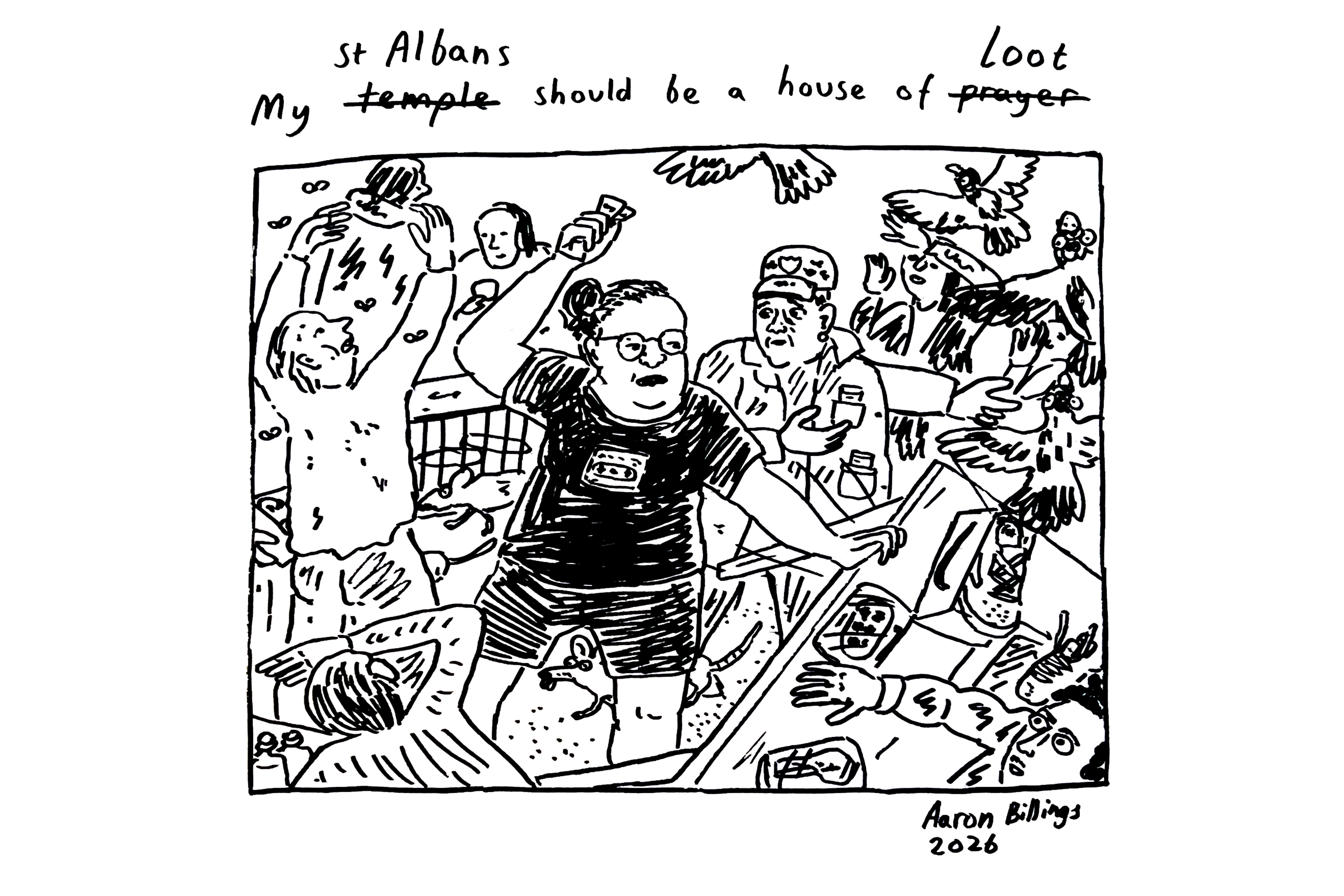
Earlier this year, we ran a workshop as part of the Brimbank Writers & Readers Festival, soliciting pitches for a Brimbank-focused piece of reportage. This week, we’re delighted to bring you the winning piece, a column by stand-up comedian Belanco Loloa. We first met Belanco years ago when he was working as a volunteer at Lentil as Anything (RIP), and we remember having a deep conversation about Edo-era Japanese prints. Since then, we’ve followed his stand-up career with interest—Oscar spoke to him for his column on the comedy scene. For this piece, Belanco is on the beat in St Albans, looking into the local hawkers. Our sincere thanks to the Brimbank Council, and especially to the Festival, for facilitating this opportunity; in a commendable display of institutional trust, they offered to pay the writers’ fee, and let us do exactly as we wanted. Here is the result.
*
“Time is short.” That’s what it says on the leaflet I’ve been given by the church fob preaching on the corner of Main Road and Alfrieda Street, St Albans. I have been here all of thirty minutes but I feel like I have stepped into a Melbourne rendition of Spike Lee’s Do The Right Thing. Every brick-and-mortar is bustling and packed to the rafters with all kinds of yams, baked goods, and boba. The ice creamery Kemoochi sells flavours I have never seen in ice cream form before. A man shouts to himself in Vietnamese, tilting side to side down the road while eating a plate of apple pastry that remains remarkably balanced in his open right hand palm. There is a fishy smell that reminds me of Preston Market. One day this area may be yearned for in similar fashion by cool-blooded, middle-class reptiles like you, me, and the guys who made Mixtape. But a council cannot plan around unrealised social capital; it needs infrastructure, resources, and investment. And before any of that, it needs to figure out what to do about the hawkers.
A “hawker” is any person who sets up shop adhoc on the side of the footpath. The “Hawker 88 Night Market” at the Queen Vic markets, for example, is a localised adaptation of the practice as it is done in South East Asia. The St Albans version sees people coming to the suburb to sell goods in clandestine setups, mainly around Alfrieda Street—then vanish as quickly as they arrived. Sometimes the goods are home-grown veggies, and sometimes they are packaged meats, cosmetics, and other brand-name sundries with a provenance you wouldn’t want to think too hard about. The Council’s name for the hawkers is a legalism coined simultaneously by every council in Australia: “Footpath Traders.”
I called the Council and spoke with a woman named Antonella, hoping to find out more about the St Albans hawkers. She told me that about two to three times a day, Council Compliance Officers patrol Alfrieda Street looking for unlicensed trading. There is also ongoing surveillance from Council cars and CCTV cameras. Bespoke retail and dining is not unfamiliar in Brimbank; there are permanent bars in the industrial district operating out of converted mechanics workshops. But if “they’re occupying Council assets,” she said, then they need permits.
Permits protect consumers from buying potentially unsafe food and protect legitimate and licensed businesses from being undercut by unregulated trade. Sometimes, when the hawkers’ goods are found to be stolen, the cops are brought in. In 2019, in a crackdown on another shadow industry, Council also co-ordinated with Victoria Police to identify and remove several unlicensed brothels operating out of massage parlours in the area. But the issue of hawkers seems to occupy a greyer area still.
Who are the hawkers and what are they selling? Why does this practice, which many a Northside flaneur would consider innocuous, create so much concern? And if I shop there for my sharehouse, can I save money? I have a team of radical activists on the NDIS to feed, and nobody can live off blanched kale alone. I asked some Melbourne-native friends to orient me to this place. A lot of their comments were negative. “It’s a shithole,” said one. “It’s just like your part of Reservoir.” Onan, western resident and known patron of massage parlours (a HICAPS receipt fell out of his wallet one time), had heard about the hawkers. “Some people grow food in their backyard and sell it there,” he told me, arms folded. Which people? He shrugged: “...Ethnics.”
*
Wogs and fobs do indeed make up a big part of the scene I am observing right now from my vantage point—a seat at a chicken shop. It is a brisk, sunny autumn Sunday afternoon. Vietnamese families rush about their weekly grocery run. Uncles are gambling on the traffic island over what looks like a game of Three Card Monte. The island has been gated off from the road, like a backyard pool or a Maccas playground. Just as in a backyard pool, the men are pissing in the foliage that was planted to dampen the sound from the road. A group of umarells (old Italian men who loiter in public spaces) in high vis polar fleece gather next to a power transformer in the square and drink premix directly under a sign that reads, “No open containers: fines apply.” A Harley pulls onto the kerb, and a man in a leather jacket with long gray hair hops off and greets everyone. He looks as if he could be my uncle Latu. I resolve to ask him if he knows of or has seen any footpath trading. “No.” He holds his fist out to me and I bump it. “Have a good day brother,” he says. This guy fucks.
Earlier this decade, in Footscray, the previously vibrant hawker community was chased out of town. This may or may not have contributed to an increase in activity in nearby St Albans. Posters similar to the large bi-lingual placards there, which read “selling and displaying food or goods without a permit is a public health matter,” now hang on the side of the KFL. Walls-of-shame that scale an entire shop’s entrance, showing shoplifters from unflatteringly forensic angles, are not uncommon here, nor in Footscray, Braybrook, or the rest of western Melbourne.
I am making my way down the road when I see five middle-aged women crowding around a man with a shopping trolley. They are haggling over a pair of pastel-pink leather Mollini trainers. “Twenty,” says the woman, which kicks him into a whinge: “No mate, I’m not selling them for less than forty. These are selling in town for $200.” I take a photo of the shoes, saying that they are for a friend. Suddenly, out of the corner of my eye, I see a Council Compliance Officer: a bald-headed white guy wearing a body-cam and Brimbank insignia high vis. With tribal tatts on the arm and wrap-around sunnies, he looks like a police academy reject. He spends the next five minutes shaking hands with store owners and sauntering into a store to buy chocolate milk, missing the Mollini trainer action entirely. The hawker finally gives up the ghost, shoves everything into a box and wheels away, passing the CCO like nothing happened.
*
From the brief conversations I’ve had so far, I understand two things: First, that everyone is well aware of the hawkers’ presence in St Albans, and second, that the authorities are lacking the resources to do much about them. The Council’s responsibility to stop footpath trading lies mostly within a framework of community advocacy, awareness, and enforcement based on food safety regulation. Stolen goods, on the other hand, are the responsibility of the police. Mayor Virginia Tachos has been quite vocal in media appearances on 9 NEWS, and more importantly, Facebook: “We need more police in Brimbank and Keilor Downs police stations hours restored!”
Brimbank politicians often speak about the drain of resources away from the west. In chamber meetings last year, Council noted a need for increased police presence being hampered by Victoria Police’s “requirements to attend major events, rallies and protests away from Brimbank.” Recently, Maria Kerr, Councillor for Copernicus Ward and current Deputy Mayor, quit the Liberals and announced she’s shopping for a new party. On a Facebook post she replied that she isn’t interested in Labor or the Greens, “nor would they have me LOL.” The most likely candidate? “So far I can say from what I have experienced one nation in the west [...] is representing ordinary people.”
The “ordinary people” of St Albans range from mental hospital inpatients to real estate entrepreneurs. What seems to unite the town is hustle and loyalty. Everyone has something going on and they are all Brimbank proud; they make it known that they can sniff out someone from outside of town. “I’m not going to be a part of your hit piece,” Sebastian Agricola, head of the St Albans Business Group Association Inc., says to me over the phone. I meet one of the Compliance Officers as he is on patrol, walking past the umarells and I. He brushes me off in similar fashion: “Mate, I can’t talk in an official capacity.”
What is it about me that conveys I cannot handle an official comment? Outside of my day job, I’m a stand-up comedian, and I have a sneaking suspicion that my years of open mic antics have rendered me eternally insincere. My friends and I deal with the comedy scene’s lumpenproletariat, on the circuit with those who are too offensive, crazy, or just plain not funny enough to do any other gig. White Australian comedians who dote on a select batch of tokens, the way Rhonda loved Ketut, take our vision for the scene entirely unseriously. Without prestige or chauvinism, only an irony-reinforced willpower to destroy the arts, we host the rest of the brown guys who treat the stage like their own personal ESL class for the practice of African-American Vernacular English. In the intentional act of cultivating this persona for myself I thought that people may take a chuddy, Polynesian 4channer as a novelty. I have come to realise that at sites of uncertainty, inner city people will simply consider me as a superpredator. In Brimbank, though, I do not assert myself, I do not stick out, and I am happily able to go incognito as just another fob.
Another good thing about looking like a ball runner filming pranks for YouTube is that I feel safe at night which, according to a Council survey taken late last year, is a problem for 54% of people around these parts. After dusk one Saturday, I come shopping for ingredients to make my dad’s sweet soy BBQ wings recipe. The street is dimly lit. Gamblers are still on the island. The bottle-o is now shuttered with its register brought up to display, empty, at the entrance. A shopkeeper serves me two singles of Asahi Super Dry through padlocked sliding doors. Next to the store lies a derelict community food bank box. The top is painted with the phrase, “Give what you can, Take what you need.” There’s nothing in it.
I hear distant music, which I follow down to the main road. A man sees me walking and jovially tells me that I need to have a rest. For all that’s said about how scary this area is, I generally find people to be quite warm. Patrols have stopped for the day but there are no hawkers around, so I stop at a greengrocer to buy some sweet potatoes as big as my forearms. The checkout lady and I stumble through a wordless conversation together using body language about how she accidentally scanned some dumpling pastries with my kumala. It is awkward but we are both smiling. Finally, I get to the source of the music: three uncles having knock-off drinks in front of the Vietnamese grocery store on Main Rd, singing with a karaoke speaker directed at the peak hour traffic on the street.
*
The following week, I get a call from Paul* (name changed for privacy), a St Albans local who offered to plant a banana tree for my roommates in our backyard. Paul used to work as a petroleum engineer in PNG, but witnessing people die on the job made him reconsider the vocation. He now focuses on raising his children, doing community gardening and some demolition work on the side. He has helped with a few gardens around Brimbank and tells me that he knows of some people who sell produce. “I like to garden because it helps keep that relation,” he tells me over tea.
Paul told me that the cost of living crisis may have exacerbated the hawker issue. With Coles and Woolies price gouging, and eggs up 30%, it’s understandable that residents are taking matters into their own hands. Paul suggested that I check out the community center, the Tin Shed, just around the corner from Alfrieda Street, to get a sense of the situation. The shed itself is a community hall made from a repurposed grain silo, similar to a military cantonment. There is a food hamper service running on the day I go. Two lines of barricades demarcate lines to the registration desk, and then funnel people to either a desk with fresh produce, or to a desk with bread and non-perishables. These are for people with health care cards, and food is sourced from foodbanks, a Lions community garden, and other initiatives. The manager Tamara Carr tells me that food is generally not sourced from private donations. “We try and forward those people on to the proper resources where available,” she says. “This is a quiet day for us,” says a volunteer. “Three weeks ago the line was so long it went out the door.”
It’s a far cry from my part of the North where, although there are still shardies hoverboarding around at night, the yards are full of NIMBY placards, the school windows are full of MINUS18 paraphernalia, and the dads come to pick-up wearing “HARRIS/WALZ ‘24” shirts. St Albans hasn’t been gentrified in this way yet, not even close.
Instead, the area activates deep memories from my childhood of the other greater west, of nights at my grandparent’s commission house in Yennora, and with my family in Emu Plains, Bankstown, and Mount Druitt. Memories of my cousin biting my finger out of boredom at vigils and getting happy meals coming home down the M4, passing by a Parramatta with no skyscrapers. Of my mother tucking me into bed explaining that sometimes the police make mistakes, and that my cousin went to sleep in an overnight prison stay and won’t be waking up. Paul brings his son over and they plant the banana tree together, and I think about how such phantasms reverberated in the minds of my parents. When I would get bad report cards in high school, dad would yell at me that we moved to regional Tasmania to keep us out of trouble. I was, and am still, lucky.
On my final visit to St Albans, I am on a mission to buy produce for dinner. As I walk past the Westpac, I see a Caucasian woman with scratch marks on her arms and a scab on her cheek the size of a five cent coin set a handful of cooler bags down behind the cover of a public bin. Jackpot. I recognise the beef short ribs and magnesium she is selling as brands I have seen at the IGA. I have my eyes on the ribs, four packs at $10 each (about a $5 saving per pack from the supermarket), but before I can withdraw cash someone’s aunty swoops everything up. The seller packs up, deposits half of the money in each of the two ATMs on the street, hops on a bus, and disappears.