

Land Down Under
Cameron Hurst on the local accelerationists.
The first sign that I was in the right spot was the guy in the hammer and sickle t-shirt and business blazer. Dialectics. We were standing at the intersection of Sydney Road and Blyth Street, looking towards the dumpy brick Brunswick Baptist Church. The lights flashed green. The man and I crossed the road and entered an alleyway to the right of the church, joining a stream of people heading to the launch of Vincent Lê’s book, Unknown Lands: Decoding Nick Land’s Accelerationist Philosophy.
Lê is a Melbourne-by-way-of-Adelaide philosopher in his early 30s. He teaches casually, writes prolifically, and publishes at a delay; he wrote the bulk of Unknown Lands in 2017-18, years before Land became the subject of a spate of mainstream media articles labelling him the “dark magus of AI” and “Silicon Valley’s Favourite Doomsaying Philosopher.” Lê’s is the first book-length appraisal of Land’s ideas, published by Index Press, a local independent publisher. This is somewhat odd, but it is also understandable—Land is one of the most subculturally influential thinkers of our technoapocalyptic moment, but a proper engagement with his ideas requires communing with literal demons. Not every scholar is willing to get sufficiently occulted. Lê is.
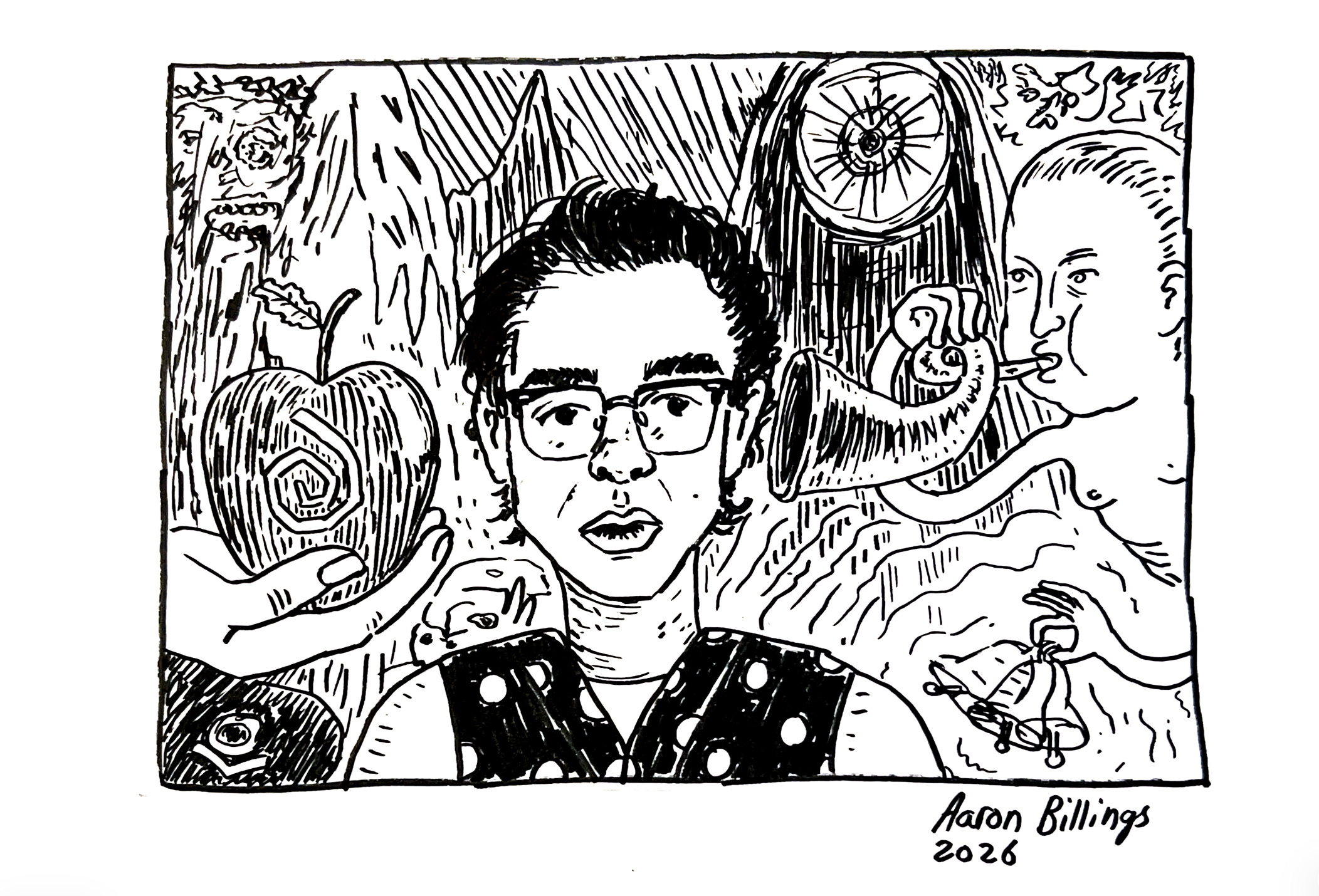
Land is the key figure associated with “accelerationism,” an anti-humanist philosophical movement that is committed to speeding-up the cataclysmic forces of capitalism in order for it to more rapidly destroy the world as we know it. Broadly speaking, humanism holds that humans possess a supreme and unique capacity for rationality and reason, and that these are engines of positive social and political organisation and historical progress. This is narcissistically and naively anthropocentric, goes the anti-humanist view. There are entities, worlds, and processes that exist outside of human comprehension. This idea might superficially share traits with the cosy post-humanism chronicled by The Paris End’s cartoonist Aaron Billings last year, when RMIT academics went land-swimming on trams in a bid to fix the polycrisis. But they are not the same.
In Land’s view, capitalism is one of these non-human entities; it is a kind of artificial superintelligence. Ultimately, it will create the technology that will replace us, technology that we cannot even conceive of. As he once put it, “human brains are to thinking what medieval villages were to engineering: antechambers to experimentation, cramped and parochial places to be.” This situation should not be cause for moralising, dismay, deluded attempts at prohibitive action, or wallowing in existential horror. It’s exhilarating. And even if you don’t find it exhilarating, well, what you think doesn’t matter, because soon the unthinkable superhumanness of the singularity will be here—if it isn’t already—and in the face of it we may as well be gnats.
In 2026, accelerationism has become somewhat mainstream in light of the rapid progress of artificial intelligence technologies. The most obvious manifestation is the LLM boom: the fact that ChatGPT is everywhere. Yet accelerationism has gone through many phases and political affiliations. There was a long moment in the 2010s where left accelerationist manifestos proliferated, advocating for things like “fully automated luxury communism.” L/Acc has died down in recent years—in 2025, Benjamin Noys, who is credited with actually coining the term “accelerationism,” wrote an e-flux article calling it a “corpse.” Meanwhile, the concept has also become associated with white supremacist groups. Last year, the Australian government listed Terrorgram, a decentralised group of neo-Nazis who wish to “accelerate” race war through acts of extreme, targeted violence, as a terrorist organisation. Many prominent figures with views that could be described as accelerationist are personal freedom-loving technolibertarian venture capitalists, like Peter Thiel, or Balaji Srinivasan, who has proposed that like-minded individuals could secede from the nation state system via “network states” hosted on crowdfunded archipelagos and run on cryptocurrency financial systems.
Land’s resolutely anti-human approach extends to biography. In a recent interview with Lê, Land reiterated his long-held argument that the “biographical stance is itself the delusion to be escaped.” In Unknown Lands, Lê refers to Land as a “sociocultural symptom,” not a mere “person.” Still, Land’s appeal surely stems, at least partly, from his life story, which is usually transmitted via a series of apocryphal anecdotes. In the 1990s, alongside Sadie Plant, Mark Fisher, Kodwo Eshun, and others, he was a member of the Cybernetic culture research unit (Ccru) at Warwick University in Coventry, England. The Ccru was a secretive organisation that the university reportedly claimed “does not, has not and will never exist.” At Warwick, Land gave unconventional lectures, like the one at the Virtual Futures 96 conference where he lay on the ground “croaking” (as one eye-witness recalled) into a mic while jungle music blared. One attendee apparently walked out in protest, shouting, “Some of us are still Marxists, you know!”
His teaching methods were also… avant-garde. He had graduate students read Deleuze and Guattari’s A Thousand Plateaus by extracting acronyms from chapter titles, then using the acronyms to create diagrams based on their position on the QWERTY keyboard. (“It was a good experiment,” Ccru affiliate Maya B. Kronic recalls in a Minority Report video interview, looking into the distance. “I don’t think qwertopology took off.”) Then, as the Millennium bug began scurrying around and the century turned, Land parted ways with the university and had a mental breakdown. Some say the breakdown was induced by his sometime-girlfriend Sadie Plant exiting Warwick mid-semester and leaving him with piles of marking; some cite excessive amphetamine use; some say it was the corporate university system; the writer Sam Kriss posited that it may have been because “there’s a thought-demon encoded into Marx’s notes for Volume III of Capital, a demon made entirely out of inferences that ended up killing Engels and driving a wedge between Bernstein and Kautsky, and which still disintegrates the mind of anyone who truly understands the law of the tendency of the rate of profit to fall.”
Whatever happened, at some point in the 2000s, Land moved to Shanghai and started writing trade travel journalism, like the Shanghai World Expo Guide (2010). The cultish reputation that the Ccru and Land had begun to develop at Warwick only grew in the wake of the meltdown and self-imposed exile. There is now a Ccru fandom wiki devoted to encyclopedic cataloguing of the organisation’s protagonists, activities, and concepts, such as “hyperstition” (most simply: fictions that make themselves real; essentially manifestation for theoryheads) and the Numogram, used for the practice of Lemurian demonism and time sorcery (most simply: there is no simple way to summarise this). Land’s sage-like appeal also stems from the fact that we seem now to be living in the world that he and the other Ccru members predicted. As Kronic puts it, in the ‘90s Land addressed “issues that at the time were decidedly outré, but are now a staple of debate: biotechnology, radical Islam, the internet as an addictive drug, the rise of China as an economic power.”
And he did it with an extremely distinctive voice. The comprehensive collection of Land’s writings from this period is Urbanomic’s anthology, Fanged Noumena, first published in 2011, now in its thirteenth edition, and available on art school kids’ bedside tables everywhere. The index gives a vivid sense of Landian themes. Under M, for example, you can search for:
machines 294, 323
madness
     and capital 265
     of capital 278
market, marketization 259, 312, 340, 347, 354
mask see camouflage
martyrdom 125, 129-33, 137
Marxism 426, 623
    and monotheism 626
    superiority of Far Eastern 447
materialism 211
    base 391
    libidinal 286, 328
    virtual 325, 329
mathematics 105, 109
    and popular numeracy 593
    as language 402
    Greek, and snake-trauma 468
On a sentence level, a Land text can range from the prophetic but basically legible to the utterly esoteric: “The future is closer than it used to be, closer than it was last week, but postmodernity remains an epoch of undead power: it’s all over yet it carries on”; “Biovirus TA TA TA targets organisms, hacking and reprogramming ATGACTTATCCACGGTACATTCAGT cellular DNA to produce more virus virus virus virus virus virus virus virus.” His writing has a caustic, disdainful style that traffics in aristocratic discernment and technophiliac provocation. “There is one simple criterion of taste in philosophy: that one avoid the vulgarity of anthropomorphism,” Land wrote in his only full-length book, The Thirst for Annihilation: Georges Bataille and Virulent Nihilism, in which he describes a set of ideas that are “perhaps less a philosophy than an offence.” Die, humanism.
In the 2000s, his work continued circulating amongst artists, writers, and forum-dwellers interested in cyberguerrilla warfare and the academic left’s critique of capitalism. But by the 2010s, he had begun developing a new reputation—as a conservative, or even a fascist. This was due to his vocal participation in a new subculture: the “neoreactionary movement” (NRx), or “dissident right.” In 2012, Land published a lengthy text titled The Dark Enlightenment. This was a response to and development of the thought of a guy called Mencius Moldbug, aka Curtis Yarvin. Yarvin and his associates thought democracy was not working, and that it would never work; that democratic leaders should be replaced by CEO-monarchs; and that society was controlled by a progressive “Cathedral” made up of tyrannical left-liberal media and academic institutions who stood in the way of this improvement. “To call the belief in substantial human equality a superstition is to insult superstition,” reads a typical Dark Enlightenment line. In the text, Land called for, among other things, replacing representational democracy with constitutional republicanism, the “massive downsizing” of government, and the abolition of central banking in favour of hard money. “Precious metal coins and bullion deposit notes” were good. This stuff wasn’t going on the curriculum at art schools.
To fully understand the factional disputes and developments of this anti-democratic, anti-globalisation, and frequently explicitly racist coalition would require an advanced degree in Groypernomics. (I’m not too keen on enrolment.) Suffice to say that Land became an active participant in this discourse, and that between 2012 and 2026, some of its adherents went from being fringe ideologues to—despite their aversion to democracy—holding positions at the highest levels of the Trump governments. Today, a look at Land’s X is a look at Elon Musk’s dream of uncensored Twitter. It’s a morass of immigration- and race-focussed crime statistics, antisemitic theories, advocacy for something called Gnostic Calvinism, theories about right-wing influencers being on the payroll of the Southern Poverty Law Centre, and, recently, extensive commentary on a viral thought experiment: Everyone in the world has to take a private vote by pressing a red or blue button. If more than 50% of people press the blue button, everyone survives. If less than 50% of people press the blue button, only people who pressed the red button survive. Which button would you press? And can you guess Land’s choice? Spoiler: it’s not blue.
The Silicon Valley technolibertarian oligarch class, opposed to any “deccelerationist” attempts at state regulation of platform capitalism, also became interested in Land. (The software engineer and venture capitalist Marc Andreesen ordered a copy of Unknown Lands, but Lê never got Peter Thielbucks, as far as I know.) This February, Land was flown to San Francisco for a house party where he had an on-stage conversation with Yarvin, which one attendee said was “old fogey” and “proof that the Dark Enlightenment is over.” Land also had a fireside chat with Grimes. VICE, revived for the umpteenth time, is currently advertising a 2026 magazine special wherein “AI Nick Land meets AI Homer Simpson.” God knows what that means; the key point here is that over the past few decades, to use Ccru-ian language, Land has been spreading like a hypervirus. And here in Narrm/Melbourne, Vincent Lê is a superspreader.
*
The book launch event was at Oddaný Gallery, an art space and book shop in a hall at the back of the church run by a collective of preternaturally organised sylphs. Oddaný overlooks a green, mulchy garden. On this Saturday evening, in March, it was filled with about 100 people standing beneath gumtrees drinking, smoking, and chatting. The syncopated rhythms of jungle music filtered through the air. If one were to wander amongst the attendees eavesdropping, one would find that the overwhelming majority of conversations were dominated by the topic of AI. University tutors were talking about how students were using ChatGPT to write their essays, obviously, but also their emails, oral presentations, and interior monologues. Students were talking about how their lonely mums were using ChatGPT to assist with rearranging their lounge rooms. Lawyers were talking about courts backlogged by reams of paperwork generated by civilians representing themselves using ChatGPT. Single people were talking about being accused by their situationships of using ChatGPT to pen non-committal text messages.
One attendee notably not talking about AI was Peter Korotaev. Korotaev is a heavy-browed young man who runs the deep state gossip blog Events in Ukraine. He was standing with a high school teacher explaining a recent diplomatic incident involving a corrupt human-smuggling Ukrainian spook nicknamed the “Dog-Handler” (due to his love of dogs—especially miniature schnauzers), and a mysterious truck, loaded with millions of dollars in paper cash and nine bars of gold, which had been detained by Hungarians as it tried to cross the Hungary-Ukraine border. A complicated situation. As I listened to what Zelensky was doing about it, I saw a friend of a friend, an autistic, artistic young woman who, every time I had encountered her in social settings over the past four years, had at some point started muttering about Nick Land in a manner that made it seem like he had possessed her. Then I saw my co-editor Sally Olds, who wandered over and informed me that word was going around that Nick Land himself was here. I scanned the crowd for a balding, slightly jowly, hooded-eyed white British man in his early 60s, but couldn’t see the specific one I was looking for.
