

ANTIFIFA
Sally Olds is our sports reporter this week. We didn't have anyone else.
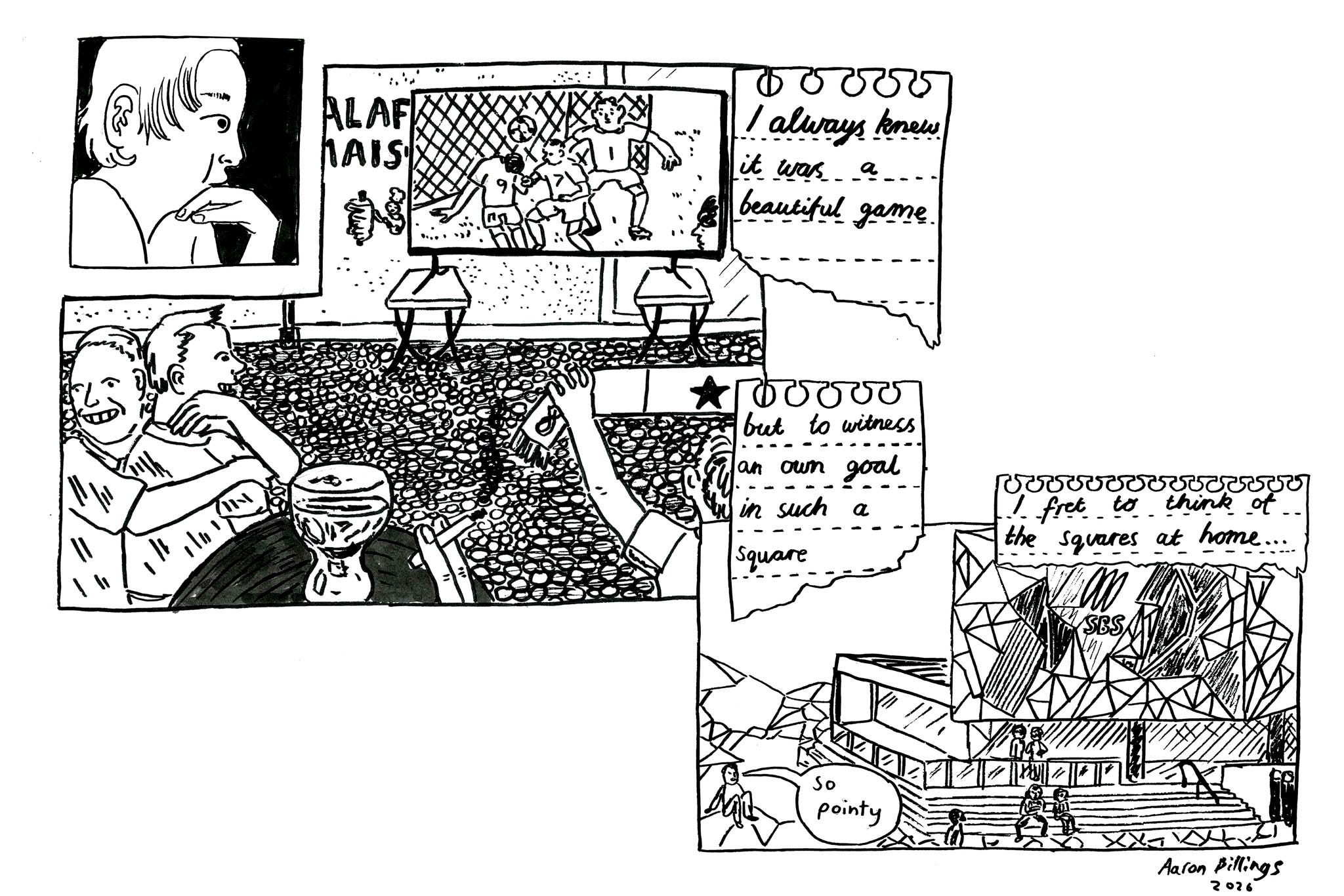
Reluctantly, I must admit to having countrymen. There they were, at a strange pub in Turin, Italy, watching Australia play Egypt in the World Cup, clustered in blonde groups with their hammy thighs out, or edging up to the bar to order a chardonnay. The Huntsman Pub, est. 1870—and it was decisively a pub, not a bar, not a taverna, not a tabacchi, nor a cafe—was in the style of a classic British haunt. It had a large corner frontage, its name in a serif font on a green sign, a pool table, an ornate, dark timber bar, and several massive flat-screen TVs. The menu offered Piedmontese staples like Scaloppine All’Arneis, but also Thai Fried Rice, Fajitas, and Tomahawk Steak. Over the pool table, a sign proclaimed “THIS IS BROOKLYN,” and on the walls were cartoonish decals displaying slices of pizza, crowns, and musical notes. A zig-zag outline contained the word “Crisp.”
The discerning tourist wants, most of all, not to be a tourist. In Marseille I was constantly shocked by the thin, bronzed, long-haired French girls, shod in leather sandals and drinking espresso, who opened their mouths and revealed themselves to be Australian. The discerning tourist avoids like the plague the other kind of tourist, especially her own countrypeople, contact with whom would degrade her act. For the other kind, there is no shame in joining the walking tour, wearing the Hokas, ordering the cappuccino, speaking in English. In being at peace with their position, they transcend it. They are not constrained by the anxieties of assimilation. They are free.
The Huntsman was a kind of cathedral for this latter type. Sitting in the front bar was a group of Australian men not speaking to each other, fixated on the screen. A blonde family filed past me as I ordered a beer at the bar, sticking close together: mum in a white blouse, daughter in a skimpier version of the same white blouse, dad in beige chino shorts and a button-up shirt, son in pale blue chino shorts and a button-up shirt. Sydney? Noosa. I was there because I was staying with a friend whose graduating class at the International University College of Turin—a tiny, politically-charged, independent university run by Ugo Mattei, a local legal scholar descended from anti-fascist Partisans, who had recently spearheaded protests against Italy’s COVID vaccine mandates and successful legal reform for the commoning of Italian waterways—were going there to watch the match and celebrate the end of the semester.
I had also told my fellow editors I would report on the World Cup in Istanbul, Marseille, and Turin—all historically and presently soccer-mad places—despite not having much natural interest in the sport. I had caught a few games so far, or at least parts of them. I was around other people who were watching them. But there was so much else to see.
In Istanbul, Türkiye had played Australia at 7am local time—too early, nothing was open, and anyway, I was asleep. Later that day, I saw what I thought were two sunburned athletes watching the game back on their phones. They both had sweatbands around their ruddy foreheads, above which their scalps swelled like frankfurters whose meat had broken through their own skin. Responding to a piece of game play, one of them tutted and said “Blewdy hell,” and I realised they were hair transplant pilgrims from England.
The night that Senegal played France, I was in Marseille, seeing my first opera—14 euros for Verdi’s Rigoletto in a towering, gilded, eighteenth-century building that looks like a wedding cake. It was packed, swampy with heat. I was with Kat, my partner, who left at intermission to watch the match. I stayed, fanning myself with the program and getting Claude to bring up the next act’s key plot points so I could follow along (basically, the court jester Rigoletto tries to keep his beautiful daughter away from the licentious Duke of Mantua, but, due to a curse placed on him by a cuckolded Count whom he has ruthlessly mocked, Gilda sacrifices herself to save the Duke, who had, just moments before, been chatting up another woman. Gilda, please). In the last moments, Gilda dies singing in her father’s arms. Thunderous applause. I slipped out during the standing ovation and clip-clopped down to the balcony that overlooks the square. It was full of people cheering and screaming, their faces upturned in my direction. Thunderous applause. For me?!
I realised that the bar down in the square was projecting the game on a wall just to my left. Lime scooters criss-crossed the crowd, their riders watching the match on the tiny phone screens fixed to the handlebars. Kat was sitting in a mass of a hundred or so people a few blocks away, all viewing the game on a TV in front of a bar. France scored and a Senegal supporter threw his beer glass on the ground in disgust. The bartender watched unperturbed, swept up the shattered glass, and brought the man a new drink.
I did a little better the next night. Kat and I met up with a friend at Place Jean Jaurès to watch USA vs Australia. The square is huge, bisected by a ramshackle playground and a road, and ringed by a dozen cafes. The waiters had small satchel bags and black plastic round trays and were as coordinated and swift as triage nurses. Unless you count Fed Square, which I don’t think you should, there are no town squares in the centre of Narrm. The lawn of the State Library counts more as a square than Fed Square. The man who is often there wearing flowing tie-dyed clothes, who spreads his arms and lets pigeons land all over him, contains the spirit of the square. His kin is the young guy at Piazza Santa Giulia who begged Kat to connect to his speaker (he claimed that his phone was dead) and “play something! You are gorgeous!”
The cafes at Place Jean Jaurès had all hauled out large TV screens for the game. The one we settled in front of was so big that it didn’t fit on one table. One leg was jockey-strapped to one table, the other leg jockey-strapped to another, and the body of the TV spanned the empty space below. We drank opalescent pastis and sweated. Australia lost.
*
Finally, in Turin, I was in the sports pub with my countryfolk and some members of the international left. Kat was showing a guy from the DRC Dustin Martin highlight reels on their phone, explaining that this was our national football. I was asking an anarchist from Austin to list the components of peach cobbler, his favourite American desert. It was July 3rd, an auspicious date for radicals. On July 3rd, 1969, workers at the Fiat factory in Mirafiori, Turin, went on strike. Alongside residents and students, they faced off against police at Corso Traiano. The confrontation was violent, and it raged for the next couple of days. The police had tear gas and batons, and the protestors had rocks and barricades. It led to dozens of arrests and injuries, but also a recomposition of labour laws, union tactics, and working-class struggle. It’s said to have inaugurated the “Hot Autumn”—a period of revolutionary fervour in Italy marked by widespread factory strikes, rent strikes, student strikes, riots.
A young Turin-born footballer, Paolo Sollier, was working at the Fiat factory in 1969. “[E]verything turned upside down, the experiences in the factory, the July 3rd of Corso Traiano, the batons that rained down on us, me escaping up a tree,” Sollier wrote in his 1976 memoir, Kicks, Spits, and Headers. He became infamous in Italy as the militant leftist footballer; there were others who shared his political persuasions, but he was handsome and bearded, and he did meme-able things like greet fans with a raised, closed fist, and the press glommed onto him. Sollier writes of refusing to sign autographs, arguing that they reinforce the alienated relation of celebrity to fan. He discovers that one of his comrades is a spy who sold out a guerilla leader in Bolivia. He bitches about the Italian Communist Party as a crusty, stultifying force. He laments the way the left has always avoided sports “because of a question of priorities, but also because of its own inability,” which makes him an outlier both in his leftist circles and his sporting ones. “Jokes about me,” he writes, recounting a commentator’s spin during a game. “Why is Sollier still running so hard, there’s hardly any time left, and they are winning three to one. He has to, he’s in Lotta Continua.” (Lotta Continua was a workerist political group whose name translates to “continuous struggle.”)
Perhaps most intriguingly, he also spends several paragraphs agonising over a beautiful blonde fascist with whom he is romantically entwined. “I know she’s fascist, because they told me so, because she told me, because she told me that Potere Operaio almost got her with a Molotov, in an MSI [fascist political party] office.” Eventually, she shifts her alignment to anarchism (anarchists should take this as a cautionary tale). “She’s changed. She’s no longer a fascist, she’s no longer a curse, and she’s no longer distant.” Nothing stands between them now… Except that his infatuation has suddenly vanished. “The simplicity of my nonsense is amazing,” he writes.
The political clash is not always sexy. Sollier needed bodyguards after his club received threats against him, most likely from fascist ultras. “Ultras” are highly organised groups of fans that show extreme allegiance to their local club. They stage theatrics at games and often get into fights with other fans, struggling for turf in the curve, the area just behind the nets. This year, ultras at one of the World Cup qualifiers, Italy vs Northern Ireland, booted parents and kids out of ticketed seats so they could occupy the coveted area. (This didn’t help Italy make it through.) Ultra groups have flags and uniforms and headquarters. Some have links to the mafia. The Drughi, a Piedmontese group, apparently have a banner of Mussolini hanging in their club house in Mirafiori. There are left-wing ultras, too, who tend to do more likeable things, such as run foodbanks and organise local footy tournaments.
It’s hard for me to imagine voluntarily enlisting in the “Green and Gold Army” that accompanies the Socceroos to matches and dons bright yellow mullet wigs and green nose zinc, just as I didn’t want to be associated with the other Australian tourists at the bar. While travelling, locals would continually guess where I was from. I was flattered when I received French, Belgian, German (maybe it was the loafers) and offended by American (I did wear Hokas some days). Being free of nationality was not an option. At the start of the Egypt vs Australia game, one of the students at our table, an American in a Free Palestine T-shirt, goaded: “Australians aren’t allowed to be patriotic!” We knew this, and had already made a kind of non-aligned flag of two French fries spiked on a toothpick and dabbed with sauce, which we waved around. But the World Cup demands allegiance, identification. An Egyptian woman from the course told us so explicitly: we were to root for Australia so that she had antagonists to spar with. A neat resolution presented itself when Egypt scored an own goal. We had got the point, but Egypt had kicked it in. Our cheering was politically sound.
Australia and Egypt were now one-all. As we entered penalties, the mood in the bar and on the street grew both more raucous and more tense. I had been noticing the many Fiats in Turin—tiny, Richard Scarry, toy-town cars—because of Sollier and July 3rd. Also, because in Italy, P-platers tag their cars not with small green squares as in Australia but with shameful A4 print-outs emblazoned with a giant P. Many of these big Ps were now flashing past the windows, the cars honking, the passengers hanging out the windows yelling.
Of course, Egypt won after our 18-year-old missed a goal. The students roared in triumph. The Egyptian woman brandished an Egyptian flag that she had unfurled from somewhere, while, on screen, the Egyptian coach waved a Palestinian flag. The group of Australian blokes stayed in their seats and drank silently for the next thirty minutes, before telepathically arranging to rise at the exact same moment, and filing out of the pub.